WAAT was issued a temporary-station grant for two days, April 16th and 19th, 1922, and never received a standard broadcasting licence. Even so, somehow it remained on the air until October.
Radio Digest, June 24, 1922, page 5:
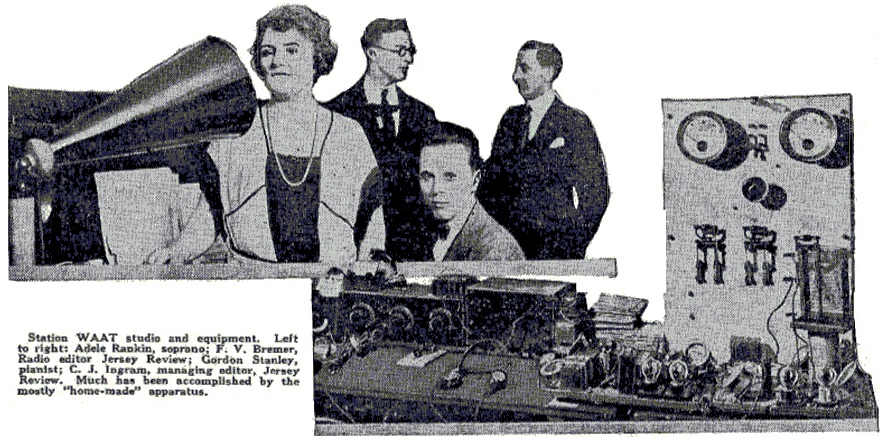
WAAT, Jersey Review Claims Pioneer Honor
_________
Began Broadcasts Before Amateur Stations Were Barred
____
By Frank V. Bremer
(Special to RADIO DIGEST)
Radiophone station WAAT operated by the Jersey Review, Jersey City, N. J., was one of the first stations in the United States to operate on a regular scheduled program. The station formerly known was 2IA was licensed as an amateur station and used for the first time on January 11, 1922 for Radiophone work. Previously, except during the war period, Station 2IA had been a spark transmitter.
On January 11, 1922 a regular schedule of Radiophone broadcasting was commenced by the Jersey Review. At that time the ban had not been placed upon amateur broadcasting and the station operated on a wavelength of 200 meters. Regular programs ever since that time have been broadcast on Wednesday and Sunday evenings, commencing at 6:57 p. m. with a phonograph record for a tuning test, and continuing for about an hour or a little more.
Heard Over Wide Area
When the government placed a ban on amateur broadcasting, station 2IA was changed to WAAT and commenced operating on 360 meters.
Low power is used at WAAT and modulation rather than distance is sought.
The programs have been reported by over 1,100 stations, having been heard by operators in the first, second, third, fourth, fifth, eighth, and ninth districts. This is remarkable when it is considered that Station WAAT uses but 2 five-watt tubes for oscillators, 2 five-watt tubes for modulators, and one five-watt tube as speech amplifier. The greatest distance WAAT has been heard is Memphis, Tenn., where Station 5EK managed to tune in. Programs from WAAT are regularly tuned in at points 150 miles away and all report exceptionally fine modulation.
Broadcast Concerts Mainly
Programs broadcasted by the Jersey Review are principally of the concert or operatic type, though an occasional evening of dance music and 'Radio party' is broadcasted. That the offerings are appreciated is attested by the enthusiastic phone reports that are received at the station during a program.
On Wednesdays the program is usually a fifteen minute address by a prominent judge, or leader in some profession, and followed by a concert given by well known vocal and instrumental artists. On Sunday evening a half hour Radio chapel Vesper service is broadcast from 7 to 7:30 p. m. following which a musicale is given.
Experiments With Acoustics
The station is located in a private dwelling where the living room is used as a studio. The room is so constructed that the acoustics are ideal. No trouble is experienced with echos or rebounds. Carpet on the floor, wall hangings, curtains, draperies, etc., make for ideal reproduction.
Most of the equipment is of the so-called "home made" variety and required a great deal of experimental and rebuilding work before the present high efficiency was attained. A system of rectified AC has been worked out that gives exceptionally fine results, and though not used is so arranged that in event of generator trouble, the set can be "thrown over" to the AC with no interruption to the broadcasting. An overheated generator bearing once during a program necessitated this change over, but the operators noticed no difference in the quality of the broadcasting.