![]() |
| Kadel & Herbert |
| 4,000,000 BASEBALL FANS HEARD HIS VOICE |
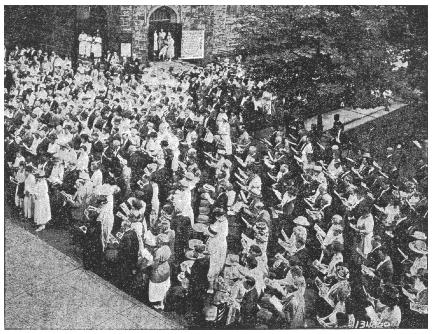
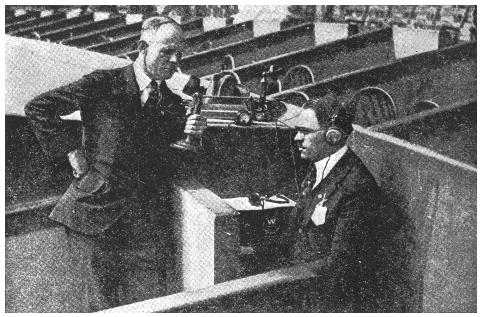
| When Grantland Rice, the popular sport editor of the "New York Tribune," broadcast from the New York Polo Grounds via WJZ his play-by-play report of the world-series baseball games, his audience was scattered over half a continent. Grand opera, symphony concerts, lectures and speeches have been similarly transmitted by wire to broadcast stations. The immediate problem before the broadcasting stations today is to obtain the wire service. |
The Broadcasting crisis in a Nutshell:
Upon the nature of the broadcast programs the public interest in radio--and consequently the immediate future of the radio industry--is hanging.
When radio first seized upon the public fancy, interest was centered on the radio apparatus itself--the mechanical medium by which the broadcast programs were received. The novelty of the instrument must inevitably pass. The public's interest is properly becoming centered on the programs themselves.
Radio is unquestionably destined to play a vital part in the affairs of men, perhaps a more vital part than has ever been played by a single invention or discovery. It is vastly more than a mere instrument for receiving jazz, bed-time stories and similar light entertainment. It has already demonstrated its significance as a great educational and cultural force. The foremost educators and publicists of the country are beginning to realize its possibilities. Radio is beginning to take its place as an instrument for rendering a world-wide public service of inestimable value.
The day when eminent musicians, lecturers and others can be induced, to visit remote broadcasting stations and entertain free of charge is passing.
To meet this situation POPULAR RADIO has proposed a nation-wide broadcasting project that offers a practical solution that can be put into immediate effect. It aims to raise the broadcast programs to the highest possible level, to the end that they may be coordinated and made to serve a great public service.
Briefly, the plan provides:
1. For the installation of permanent wiring to the more important auditoriums where musical programs, lectures by eminent scientists and publicists, and other important features are given.
2. For the transmission by wire, to a small but highly select group of powerful and adequately equipped radio stations, such programs as may be selected for broadcasting.
3. For the coordination of these important features as elements of an organized program, developed on a nation-wide scale, under the direction of properly constituted authorities that may include the country's foremost educators, scientists and patrons of the fine arts.
In other words, the plan provides for reaching out and tapping those auditoriums, lecture-rooms, opera houses, concert halls, athletic fields--possibly even the halls of Congress--to the end that the world's greatest music and the world's greatest scientists and publicists may be figuratively brought into the home of every radio fan--and eventually into every school and college.
That the project is eminently practical from a technical standpoint has been repeatedly demonstrated, notably by the broadcasting of the Philharmonic Orchestra concerts from the City College Stadium in New York last summer--an enterprise initiated by this magazine.
The project has been outlined to some of the leading educators, scientists and patrons of the fine arts in the country, who are not merely giving it their endorsement but in many cases are giving it their active cooperation.
To carry this project (or any similar project) into effect requires wires. Without wires the programs cannot be conveyed to the broadcasting stations.
The immediate problem is: How may the necessary wires be obtained?--EDITOR
![]() |
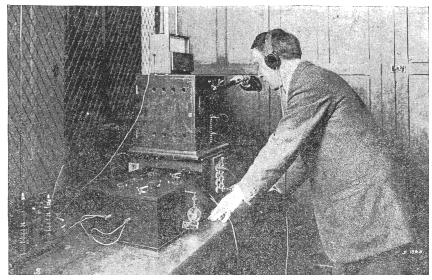
| THE MOST SIGNIFICANT STATION IN AMERICA? |
| Despite the fact that WBAY has met with unexpected technical difficulties and is still inoperative pending "experimental work," it may yet prove to be the storm center--or the solution--of the whole broadcasting problem. |
![]() |
| RADIO SERVICE TO MOVING TRAINS |
| As long ago as 1915 the Lackawanna Railroad experimented successfully with radio communication between its headquarters and its trains en route. Last August the concerts of the New York Philharmonic Orchestra were heard on Lackawanna trains in Pennsylvania. |
![]() |
| Photo by Post-Dispatch, St. Louis |
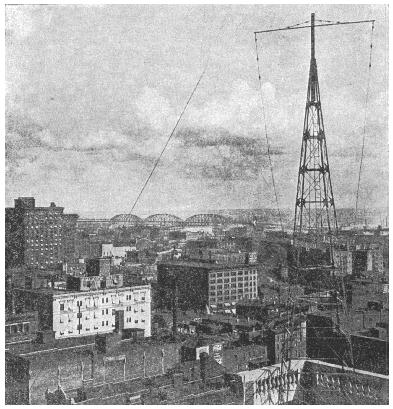
| A PILLAR ON WHICH THE RADIO INDUSTRY RESTS |
| Such broadcasting stations as this one (KSD in St. Louis) keep alive the public's interest in radio. It may soon become part of a great radio net for relaying the world's best music and the voices of the world's foremost scientists, educators and publicists into every home and school, as part of a nation-wide educational program. |
![]() |
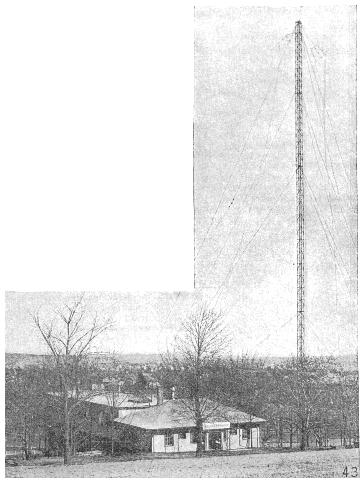
| WHO PAYS FOR SUCH STATIONS, AND WHY? |
| Properly enough, Boston's foremost broadcasting station, WGI, is located within the grounds of Tufts College. Who will eventually pay for maintaining broadcast programs? |
![]() |
| Westinghouse |
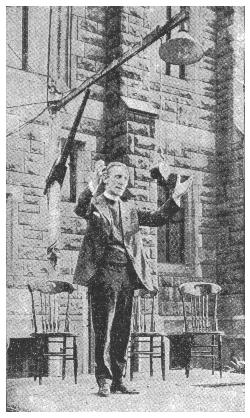
| WILL RADIO PUT THE SMALL CHURCH INTO THE DISCARD? |
| This particular community service in Pennsylvania was broadcast from KDKA. Services in the country's foremost churches may be similarly broadcast--with the aid of wires to the radio stations. |
![]() |
| Westinghouse |